
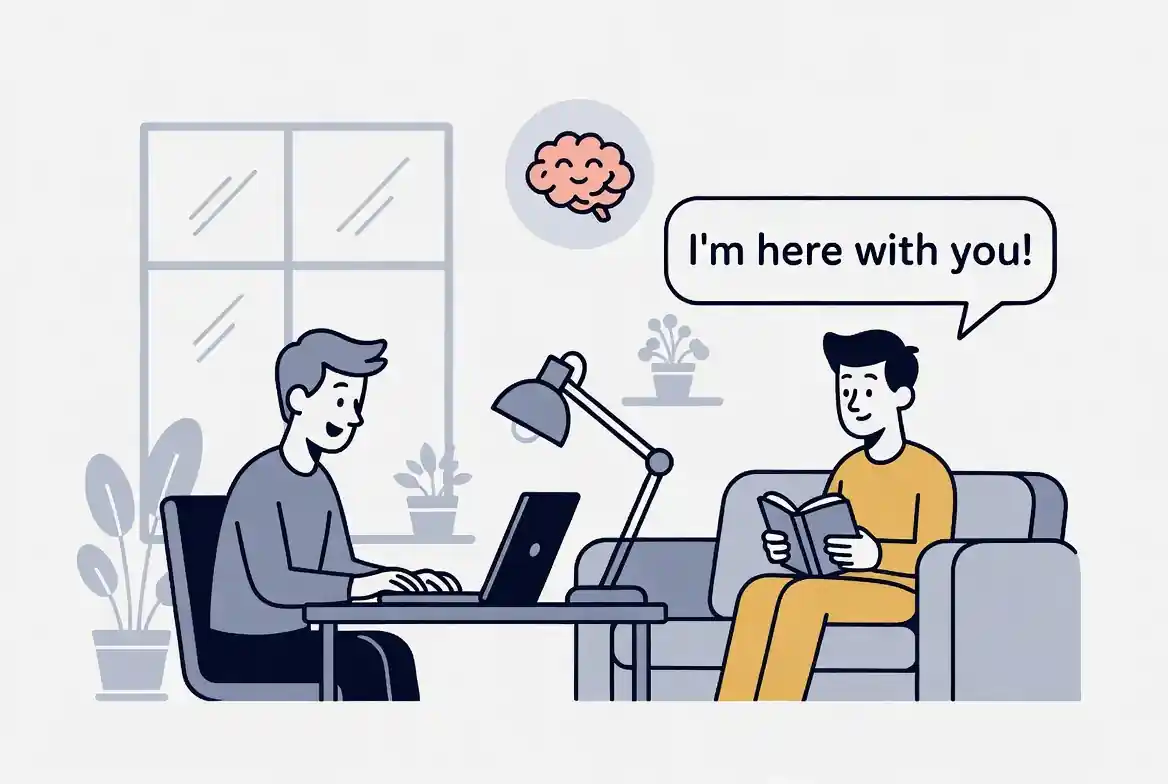
You're sitting at your desk. The task is open in front of you. You know exactly what you need to do. And yet, an hour later, you've checked your phone eleven times, reorganised your desktop, and made a second coffee you didn't need.
This isn't a discipline problem. It's a context problem. And one of the most effective - and most underrated - solutions isn't a new app, a better to-do list, or a stricter schedule. It's simply having someone else in the room.
That's the idea behind body doubling. And its virtual version is making it available to anyone, anywhere, at any hour - without needing to leave the house.
What is body doubling?
Body doubling is the practice of working in the presence of another person to improve focus and follow-through. The other person isn't helping you with your work. They're not giving feedback or checking your progress. They're simply there - working on their own thing - while you work on yours.
The term comes from the ADHD coaching community, where it has been used for decades as a practical strategy for people who struggle to initiate or sustain attention on tasks alone. But its benefits extend well beyond ADHD. Anyone who has ever worked better in a coffee shop, a library, or a busy office than they do at home alone has experienced body doubling firsthand - they just didn't have a name for it.
If you're looking for a practical example, our article on body doubling without a camera shows how that idea works in a lower-friction setup.
Why does body doubling work?
The effect is real, and the reasons behind it are well-grounded in cognitive psychology and neuroscience.
External accountability anchors attention. When another person is present - even a silent, uninvolved one - the brain registers a mild social context. That context makes it harder to justify drifting. You're less likely to open a distraction when someone, even a stranger, is nearby.
It activates the brain's social monitoring system. Humans are wired to be aware of other people. The presence of another person keeps a low-level part of the brain engaged, which indirectly supports sustained attention on a task. It's the same mechanism that makes you sit up straighter on a train than on your sofa.
It mirrors the conditions of a productive environment. Libraries and offices work partly because of social norming - everyone around you is focused, so focused behaviour feels natural. Body doubling imports that norming effect into any environment, including your bedroom at 11pm.
It reduces the weight of starting. One of the hardest parts of any task is the first five minutes. Having someone present - even virtually - creates a gentle sense of occasion that makes beginning easier. You opened the tab. The other people are working. It's time.
What is virtual body doubling?
Virtual body doubling applies the same principle online. Instead of sitting in a library or cafe, you connect to a platform where other people are working - and their presence, however mediated through a screen, produces the same anchoring effect.
It sounds like it shouldn't work. Surely a real person in the same room is more effective than a dot on a screen or a face in a grid? For some people and some tasks, that's true. But research on presence and co-working suggests that even minimal social cues - knowing that other real humans are working right now, alongside you - are enough to activate the effect for many people.
Virtual body doubling has grown rapidly since 2020, driven by the explosion of remote work and the recognition that working from home, for all its advantages, strips away the ambient social context that offices and campuses naturally provide. It's filling a gap that most remote workers didn't know they had until it was gone.
Virtual body doubling vs. video calls
It's worth being clear about what virtual body doubling is not. It's not a meeting. It's not a check-in. It's not a collaborative session or a performance review disguised as accountability.
The key distinction is passivity. In a video call, you're expected to contribute, respond, and be socially present. In a body doubling session, nobody expects anything from you. You show up, you work, and the other person's presence does its job quietly in the background.
This is why dedicated body doubling tools work better than repurposing Zoom for the same purpose. A Zoom call asks your brain to stay socially engaged - tracking faces, managing impressions, waiting for your turn to speak. That cognitive load competes directly with the task you're trying to focus on. A body doubling tool removes all of that and leaves only the presence.
How virtual body doubling works in practice
There's no single format. Virtual body doubling tools sit on a spectrum from highly structured to completely ambient:
Structured sessions - platforms like Focusmate match you with a partner for a defined 25 or 50-minute session. You both state your goals at the start, work in silence, and briefly debrief at the end. The structure creates strong accountability but requires scheduling and a camera.
Community rooms - platforms like StudyStream run live video rooms where multiple people work simultaneously. There's a social layer - leaderboards, chats, shared goals - which some people find motivating and others find distracting.
Ambient presence tools - platforms like FocusLive sit at the low-friction end of the spectrum. There's no session to book, no camera to turn on, and no social layer to navigate. You appear as an anonymous dot on a globe alongside everyone else currently working. The presence is real - these are real people, working right now - but it's stripped of everything that makes social interaction tiring.
If you want to compare that style against similar tools, our roundup of anonymous coworking spaces online is a good next read.
Most people find they gravitate toward whichever format matches their energy on a given day. High-accountability sessions for difficult tasks. Ambient presence for the ordinary grind of getting through a full workday.
Who benefits most from virtual body doubling
People with ADHD are the community that coined the term and documented its effects most thoroughly. For brains that struggle with self-initiated focus, the external social context of body doubling can make the difference between starting a task and avoiding it for another two hours.
Remote workers who have traded the ambient social energy of an office for the silence of a home desk. Virtual body doubling doesn't replace colleagues, but it restores some of what's lost when you stop commuting.
Students studying for exams or working through long reading lists alone. The library effect - focused people around you, creating a shared sense of purposeful quiet - is replicable online.
Freelancers and solopreneurs whose work days lack external structure. When no one is expecting you at a desk at 9am, virtual body doubling provides a gentle substitute for that structure.
Anyone going through a low-motivation period - burnout recovery, creative blocks, difficult life circumstances - where the bar for starting anything feels impossibly high. The social context of body doubling lowers that bar without adding pressure.
What virtual body doubling is not a substitute for
Body doubling is a focus aid, not a cure. It works best when the barrier to your work is attention and initiation, not clarity. If you don't know what you're supposed to be doing, or if the task itself is genuinely unclear, being around other focused people won't resolve that - you need to work out the task first.
It also works best as a complement to other habits - reasonable sleep, manageable workloads, breaks built into the day - rather than a workaround for chronic overload. A body doubling session won't help you focus on five competing priorities at once.
Think of it as removing one specific obstacle: the difficulty of staying at the desk long enough to do the work you already know how to do.
How to try virtual body doubling today
The lowest-friction way to try it is FocusLive. There's no account to create and no camera required. Go to focuslive.app/realtime, click "Join as guest," and you're on the globe in seconds - a dot among dots, working alongside real people from around the world.
If attention span is the real blocker once you've opened the tab, pairing this with a micro-pomodoro can work especially well.
Keep the tab open. Let the ambient music player run. Do your work. Close it when you're done.
If it works for you - and for most people, the effect is noticeable within the first session - you'll have a new tool for the days when starting feels harder than it should.
The people on the globe are already working. You can join them right now.
Try it now
Open FocusLive and experience virtual body doubling for yourself
No camera, no account, no scheduling. Join the FocusLive globe and work alongside real people from around the world - free, always.
Try virtual body doubling free on FocusLive