
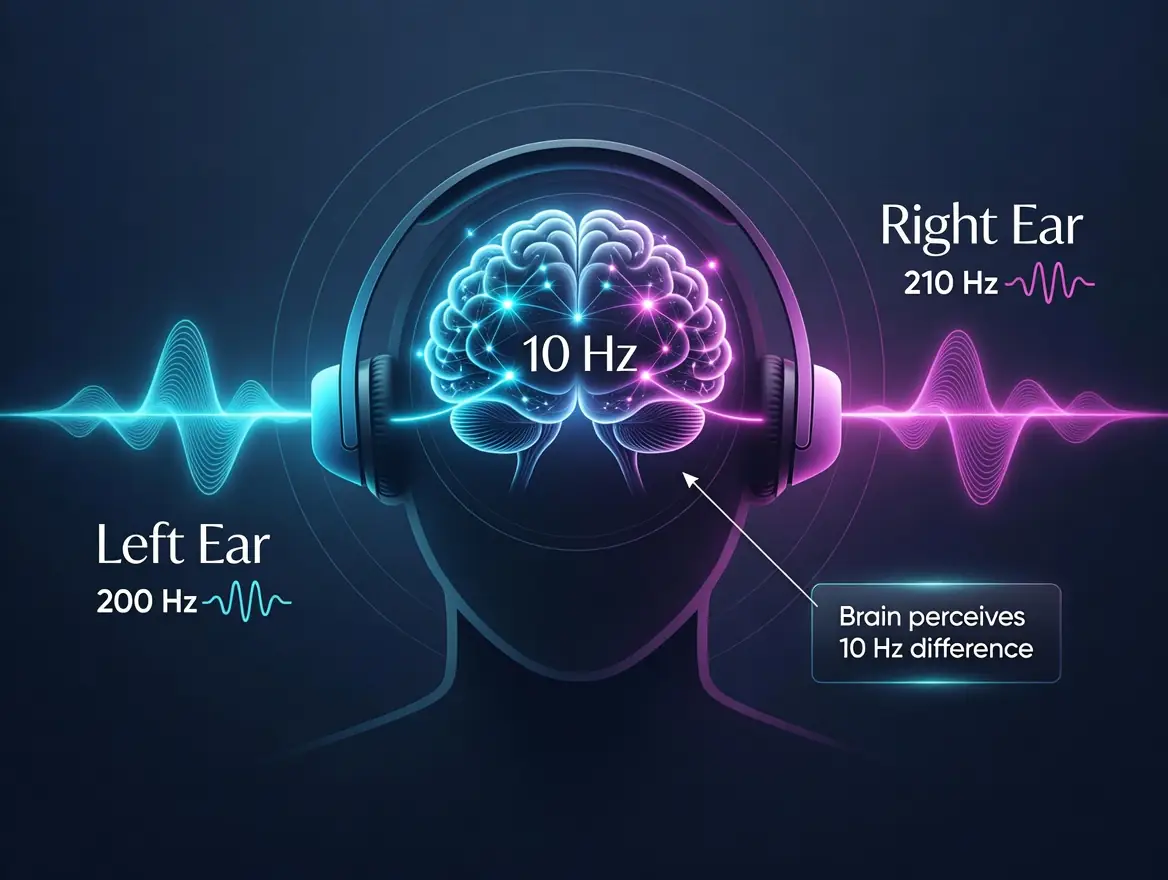
In recent years, the 40 Hz frequency has exploded across neurodiversity forums, biohacking podcasts, and academic study communities as a potential non-pharmacological focus aid for Attention Deficit Hyperactivity Disorder (ADHD).
Unlike passive ambient music or generic lofi beats, 40 Hz binaural beats sit in the gamma brainwave band—the high-frequency neural oscillations associated with complex information synthesis, sensory binding, and working memory.
Does scientific research support the hype? How does auditory gamma entrainment actually interact with the dopamine-deficient ADHD brain? And how can you practically integrate it into your work routine without triggering listening fatigue?
Below is a comprehensive, science-grounded breakdown of 40 Hz binaural beats for ADHD and cognitive performance.
Listen to a Synthesized 40 Hz Gamma Audio Preview
Put on stereo headphones to hear how dual-frequency stereo modulation creates the 40 Hz auditory illusion:
40 Hz Gamma Focus Tone (Synthesized Live)
Left: 200 Hz | Right: 240 Hz | Perceived Beat: 40 Hz
What Are 40 Hz Binaural Beats?
A binaural beat is an auditory illusion created inside the brain's brainstem (specifically within the superior olivary complex).
When you listen through stereo headphones with two slightly different frequencies in each ear—for example, 200 Hz in the left ear and 240 Hz in the right ear—your auditory cortex cannot reconcile the difference as separate sounds. Instead, it perceives a rhythmic pulsing beat equal to the mathematical difference:
Right Ear (240 Hz) - Left Ear (200 Hz) = 40 Hz (Gamma Beat Frequency)
Because 40 pulses occur per second, the frequency matches the electrical firing rate of Gamma waves (30–50 Hz) inside the cerebral cortex.
The Neuroscience: Why 40 Hz Matters for the ADHD Brain
ADHD is fundamentally characterized by dysregulation within prefrontal cortex networks—specifically lower baseline dopamine availability and reduced functional connectivity between the Default Mode Network (DMN) and the Task-Positive Network (TPN).
Here is what neuroscience reveals about how 40 Hz stimulation alters brain activity:
1. Neural Phase Locking and Gamma Synchronization
When the brain processes a steady auditory pulse, sensory neurons begin firing in rhythmic synchrony with the stimulus—a phenomenon known as Auditory Steady-State Response (ASSR). Studies utilizing electroencephalography (EEG) have demonstrated that 40 Hz auditory stimulation can increase local gamma power in the temporal and frontal lobes, regions critical for executive planning and selective attention.
2. Quenching Default Mode Network "Mind Wandering"
In ADHD individuals, the Default Mode Network (which governs daydreaming, self-referential thought, and internal dialogue) tends to remain hyperactive even when trying to concentrate on a math problem or work email. Rhythmic 40 Hz entrainment acts as an external sensory pacemaker, nudging neural activity into the Task-Positive Network and quieting intrusive internal chatter.
3. Modulating Stochastic Resonance
According to the Moderate Brain Arousal (MBA) model, neurodivergent brains require higher levels of background sensory stimulation to achieve optimal cognitive performance. In the same way that low-level white noise helps through acoustic stochastic resonance, 40 Hz stimulation provides a steady rhythmic current that raises cortical alertness without the distraction of linguistic song lyrics.
What Scientific Clinical Trials Show (The Real Evidence)
Scientific inquiry into 40 Hz stimulation spans multiple peer-reviewed studies:
- Colzato et al. (2017): Demonstrated that gamma-band binaural beats significantly improved cognitive flexibility and working memory performance in attentional control tasks.
- MIT Picower Institute Studies (Tsai et al.): Groundbreaking research investigating 40 Hz sensory stimulation demonstrated enhanced microglial activation and neural synchronization across visual and auditory cortexes.
- Frontiers in Human Neuroscience (2020 Review): Meta-analyses of auditory entrainment concluded that while individual responsiveness varies widely, binaural beats show statistically significant improvements in reducing anxiety and sustaining vigilance over long tasks.
Honest Caveat: Binaural beats are not a cure for ADHD and do not replace prescribed medical treatment. Rather, think of 40 Hz audio as high-efficiency "sensory eyeglasses"—an environmental tool that makes it easier to stay focused once you sit down to work.
Step-by-Step: The Ideal 40 Hz Study Protocol
To maximize focus benefits while avoiding auditory strain:
[ Headphones On ] ──> [ Layer 25% Pink Noise ] ──> [ 25m Timer Started ] ──> [ Work! ]
1. Always Wear Stereo Headphones
Binaural beats physically require stereo separation. If you play them out of a laptop speaker or phone, both ears hear both frequencies simultaneously, eliminating the neurological binaural illusion. (If you prefer speakers, use isochronic tones instead).
2. Smooth the Sine Tone with Pink Noise
Pure 40 Hz sine waves can sound sterile or piercing over long periods. In the FocusLive Binaural Beats Generator, mix in 20% to 30% Pink Noise. Pink noise dampens harsh high frequencies and creates a warm, waterfall-like acoustic blanket.
3. Keep Listening Sessions Bounded
Because gamma frequencies encourage high cognitive arousal, do not listen continuously for five hours straight. Use an online Pomodoro timer to bound sessions into 25 or 50-minute sprints, followed by silent breaks:
Click start to begin this focus block.
4. Press Play Only After Deciding the Task
Never listen to 40 Hz while checking notifications or tidying your desk. Press play at the exact second you open your textbook or code editor. This conditions a clean Pavlovian trigger: When 40 Hz plays, deep work begins.
Summary Comparison: 40 Hz Gamma vs. Other Frequencies
| Band | Frequency | Cognitive State | Best For |
|---|---|---|---|
| Delta | 0.5 – 4 Hz | Deep restorative sleep | Nighttime recovery |
| Theta | 4 – 8 Hz | REM sleep & deep meditation | Visualization & wind-down |
| Alpha | 8 – 12 Hz | Relaxed alertness | Reading, light reviewing |
| Beta | 12 – 30 Hz | Active problem solving | Analytical calculations |
| Gamma (40 Hz) | 30 – 50 Hz | Peak cognitive binding & hyperfocus | ADHD study sprints & complex tasks |
Try it now
Open FocusLive with the 40 Hz binaural beats generator
Customize carrier frequencies, dial in pink noise smoothing, and anchor your study sprints with science-backed sound.
Open Free Binaural Generator