
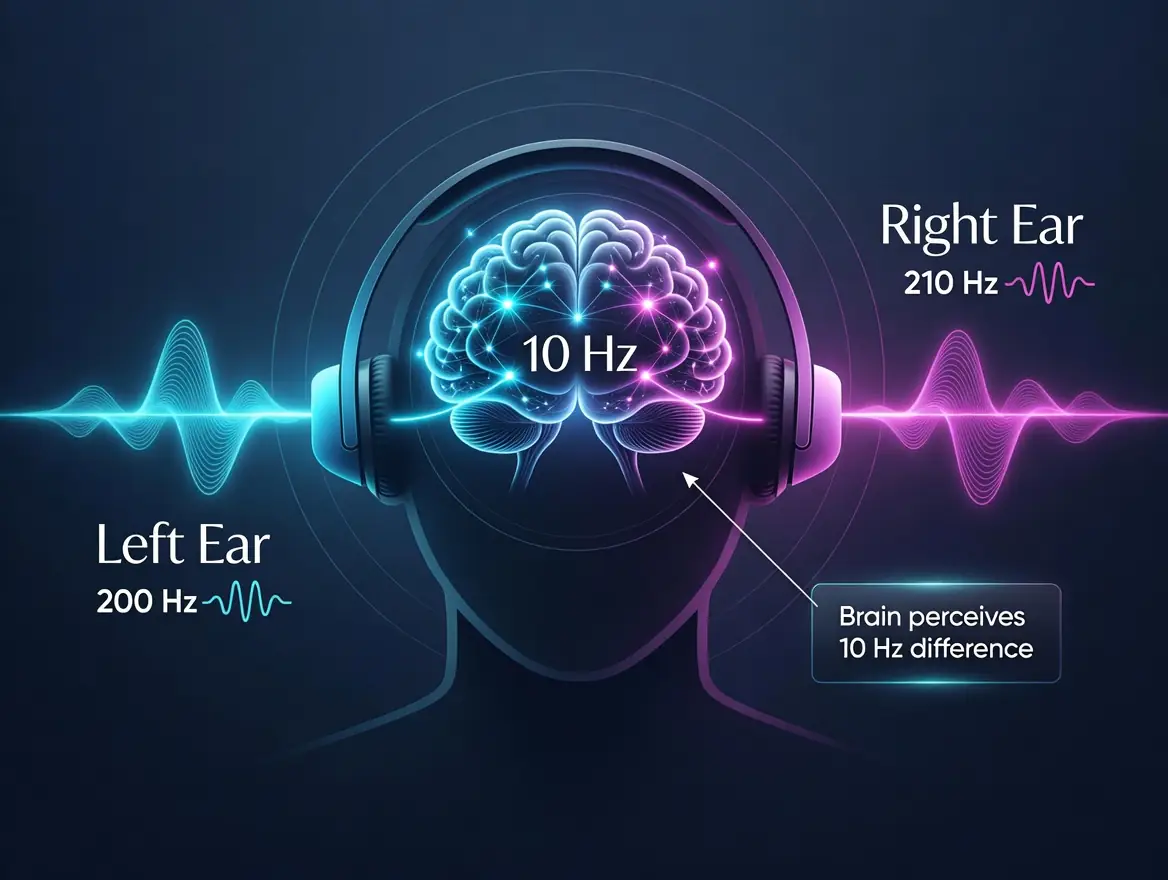
Binaural beats can sound more mysterious than they really are. At the practical level, they are just two slightly different tones, one sent to each ear, that your brain interprets as a rhythmic difference between them.
That does not mean they are magic. It means they can be a useful audio environment for some people, especially when the real problem is not knowledge, but getting into a steadier state of work.
What binaural beats actually are
If your left ear hears 200 Hz and your right ear hears 210 Hz, you do not experience those sounds as totally separate. Instead, your brain also perceives a 10 Hz difference between them. That perceived gap is the "beat."
Because the effect depends on each ear receiving a different signal, stereo headphones are required. Playing binaural beats through laptop speakers removes the setup that makes the illusion work.
Which frequencies people usually use
Most people do not start from the carrier frequency. They start from the beat frequency and choose it based on the kind of session they want.
- Around
2-4 Hzis usually associated with delta-style sleep or deep rest sessions. - Around
4-8 Hzis commonly used for theta-style meditation or wind-down time. - Around
8-12 Hzis often used for alpha-style studying, reading, and calmer concentration. - Around
12-30 Hzis usually used for beta-style focus, task execution, and alert work blocks.
Those categories are not guarantees. They are starting points. The best way to use them is experimentally: choose the state you want, try a preset, then adjust based on whether it feels grounding, distracting, or too intense.
When binaural beats are actually useful
Binaural beats tend to help most when you already know what you need to do but need a cleaner sensory backdrop to begin. That is why they pair well with structured work sessions instead of replacing them.
If your bigger issue is task initiation, using them alongside virtual body doubling can make the session feel more anchored. If your challenge is attention drift halfway through a block, pairing them with a micro-pomodoro often works better than just turning the audio louder.
Binaural beats vs. pink noise
Binaural beats and pink noise do different jobs.
Binaural beats create the stereo frequency effect. Pink noise is more like a smoothing layer. It can soften the sharpness of pure tones and mask environmental distractions such as traffic, keyboard clicks, or hallway noise.
That is why a blend can feel easier to work with than a pure sine tone on its own. If the generator sounds too clinical at first, try adding a little pink noise before giving up on the session.
A simple way to use them for studying
You do not need a ritual. A lightweight routine is usually enough:
- Put on stereo headphones.
- Choose a study or focus preset.
- Add a small amount of pink noise if the pure tones feel too exposed.
- Start one defined work block.
- Adjust after the block, not every thirty seconds during it.
If you already use a timer, the easiest pairing is to open the study timer or the binaural beats generator together and keep the session simple.
What binaural beats are not
They are not a substitute for sleep. They are not a cure for burnout. They do not automatically create concentration if the task is ambiguous, emotionally loaded, or interrupted every two minutes.
Think of them as environmental support. They can reduce friction, but they do their best work when the rest of the session design is also helping you: one task, one time block, fewer tabs, and a clear reason to stay at the desk.
Should you use them while working?
If you find that lyrics pull your attention away from reading or writing, binaural beats are worth trying. They are especially useful when you want audio presence without the narrative pull of songs, podcasts, or videos.
If you prefer richer sound, start with a gentle amount of pink noise and avoid obsessing over exact numbers. The point is not to build the perfect lab setup. The point is to make it easier to start and stay with the task in front of you.
Start simple
Use headphones, pick a preset, and run one work block before judging the result. That is enough to tell whether binaural beats belong in your focus toolkit.
Try it now
Open FocusLive with the binaural beats generator open and ready
Adjust the carrier frequency, beat frequency, and pink noise blend, then test one focused work block with headphones.
Open the binaural beats generator