
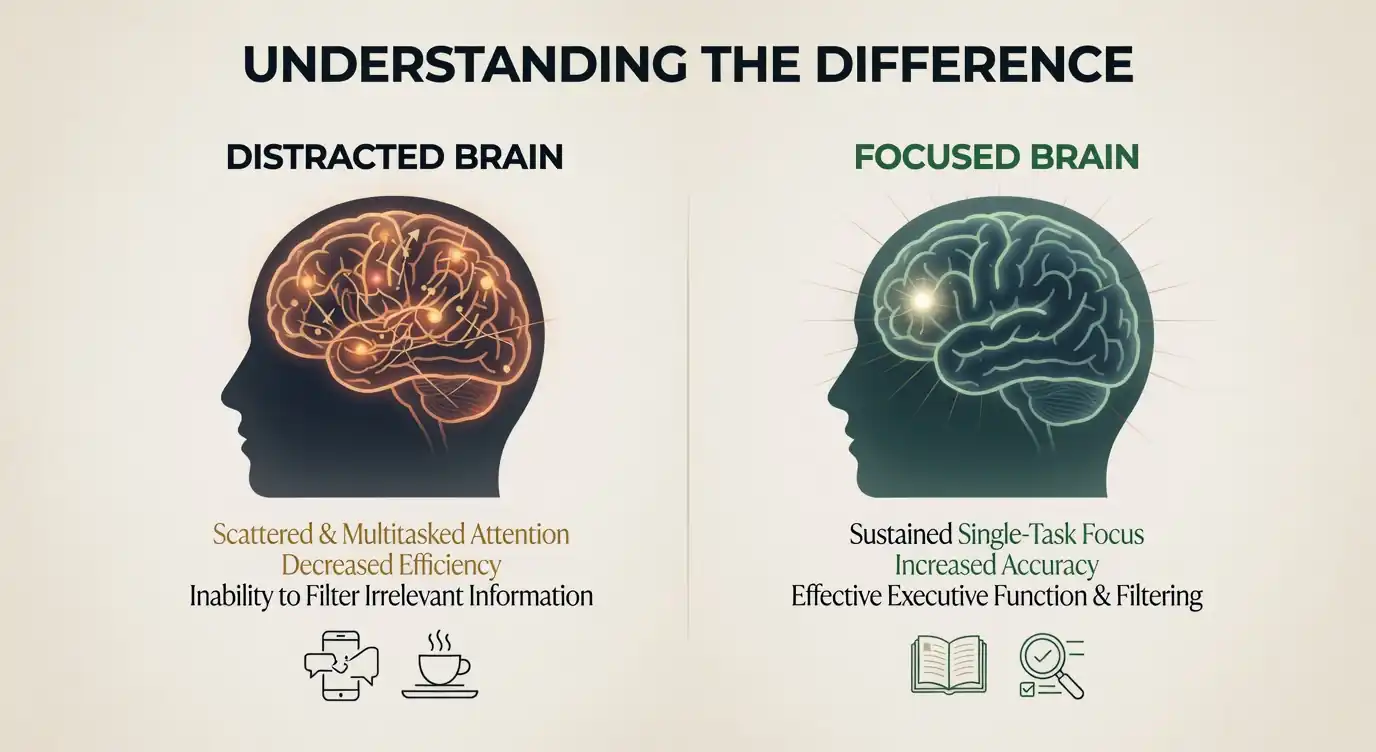
If you have ADHD, your brain is in a perpetual search for dopamine.
Because novel stimuli provide quick neurological rewards, you likely juggle thirty open browser tabs, check emails while drafting an essay, and switch tasks the moment friction appears. On the surface, this feels like energetic multitasking. In reality, it is rapid context-switching—a cognitive pattern that drains working memory, triggers overwhelm, and ends the day with five half-finished tasks and zero completions.
The antidote is not working harder or forcing impossible multi-hour focus sessions. The antidote is Monotasking: the intentional practice of executing exactly one single, bounded task until a timer sounds.
Here is why monotasking works specifically for neurodivergent brains, and how you can implement single-task sprints today.
Try a 15-Minute Monotask Sprint
When an ADHD brain feels paralyzed by a massive to-do list, committing to 45 minutes can trigger avoidance. But anyone can commit to 15 minutes on one task:
Click start to begin this focus block.
The Neurological Trap of ADHD "Multitasking"
Neuroscience has demonstrated repeatedly that the human brain does not process multiple cognitively demanding tasks in parallel. Instead, the brain engages in serial task switching.
Each time you switch from your spreadsheet to a Slack notification and back, your brain pays an Attention Residue tax:
- Dopamine Depletion: Rapid switching rapidly exhausts the limited dopamine reserves in the prefrontal cortex, leaving you feeling emotionally depleted by 2:00 PM.
- Loss of Working Memory Cache: ADHD working memory is already fragile. Switching away from a complex thought wipes out your mental cache, forcing you to spend five minutes re-reading what you were just doing.
- Catastrophic Task Inflation: A 20-minute task balloons into a 2-hour ordeal because of constant micro-distractions.
The 4 Pillars of the ADHD Monotasking Protocol
Monotasking is not about relying on willpower. It is an environmental and procedural system designed to eliminate the choice of switching.
[ Step 1: Physical Clean Slate ] ──> [ Step 2: The "Parking Lot" Pad ] ──> [ Step 3: Bounded Sprint ]
1. Close All Unrelated Tabs (The "One Window" Rule)
If you have 40 tabs open, visual cues will constantly tempt your attention. Use a tab suspender or move your active work into a clean, dedicated browser window. If you are reading a research paper, only the PDF and your notes document should be visible.
2. Keep an "Off-Ramp" Parking Lot Notepad
When you are 8 minutes into a monotask sprint, your ADHD brain will inevitably shout: "I forgot to order laundry detergent!" or "I wonder who directed that movie from 2012?"
Do not switch tabs to search for it. Instead, write it down on a physical scrap of paper (your "Parking Lot"). By capturing the thought on paper, your brain feels safe letting it go, allowing you to stay anchored in your active sprint.
3. Use Bounded, Micro-Intervals (Micro-Pomodoros)
Traditional 25-minute Pomodoros can sometimes feel too daunting on high-paralysis days. If task resistance is high, drop your sprint duration down to 10 or 15 minutes using an online Pomodoro timer. Lowering the time investment eliminates task initiation friction.
4. Deploy Auditory Blinders
Silence allows subtle domestic noises to capture attention, while songs with lyrics pull linguistic processing away from reading and writing. Monotasking thrives when paired with constant, non-melodic sensory masking:
- 40 Hz Gamma Binaural Beats: Research-backed frequency entrainment that provides steady auditory stimulation to calm internal restlessness.
- Ambient Rain & Pink Noise: A soothing acoustic blanket that drowns out sudden door clicks and keyboard noise.
Monotasking vs. Multitasking: A Daily Comparison
| Metric | Chronic Multitasking | Monotasking Sprints |
|---|---|---|
| Cognitive Fatigue | Severe (scattered brain fog) | Low (calm, focused momentum) |
| Task Completion Rate | Low (many 40% finished projects) | High (distinct, finished milestones) |
| Dopamine Satisfaction | Brief, erratic spikes from distraction | Deep, lasting satisfaction from finishing |
| Error / Typo Rate | High due to divided attention | Very low |
How to Handle the Urge to Switch
When the physical discomfort of sticking to a boring task arises, practice the "Two-Minute Rule of Boredom":
Acknowledge that boredom is simply the feeling of a dopamine drop. You do not need to fix it with YouTube or social media. Take three deep breaths, look at your timer, and tell yourself: "I will stay with this uncomfortable sentence for just two more minutes."
Nine times out of ten, pushing through that 120-second barrier drops you straight into a hyperfocus flow state.
Try it now
Open FocusLive with an online single-task timer
Pick one micro-task, eliminate background tabs, and let a clean visual timer guide your sprint to completion.
Start a Monotask Sprint