
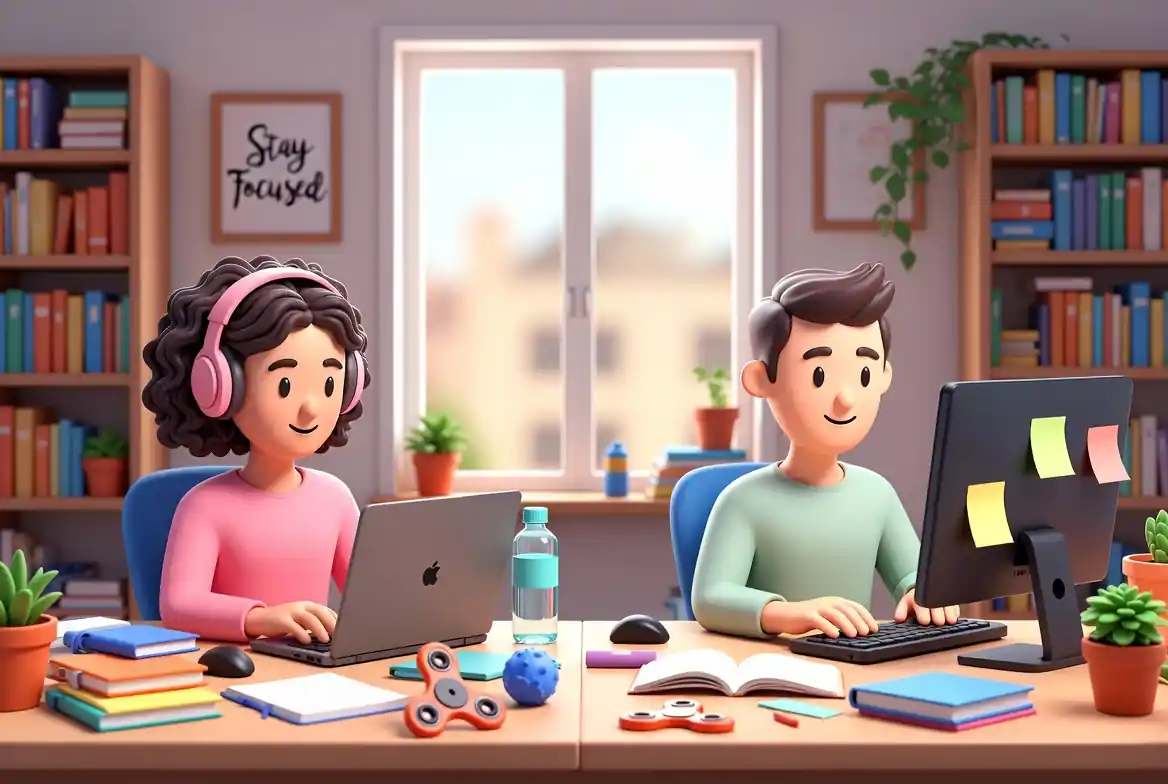
If you have ADHD, you have probably noticed something strange. A task that sits untouched for three days can get done in forty minutes when a friend happens to be sitting nearby. They are not helping. They are not even paying attention to you. They are just there.
That is body doubling. And it is one of the most practically useful strategies available to people with ADHD, even if it still sounds a little odd when you try to explain it.
What body doubling actually is
Body doubling is working in the presence of another person not because they will help you with the task, but simply because they are there. The other person is your body double.
They might be doing their own work. They might be reading. They might be on a video call with you in complete silence. Their presence is the mechanism, not their input.
The term was coined by ADHD coach Linda Anderson in the early 1990s. Since then it has become a standard strategy in ADHD coaching and is widely recommended alongside medication and therapy.
Why it works for ADHD brains
The short answer is that ADHD is not a willpower problem. It is a dopamine regulation problem. And social presence is one of the few things that can reliably shift the brain's activation state without requiring a neurochemical intervention.
Psychiatrist William Dodson describes ADHD as an interest-based nervous system. Neurotypical brains can do tasks because they are important. ADHD brains activate primarily around urgency, novelty, challenge, or a relational context. A body double introduces that relational layer without requiring conversation, collaboration, or even eye contact.
There is also a simpler mechanism at work. When you are alone, switching to something more stimulating is frictionless. When another person is present, even passively, avoidance becomes more noticeable. That low-level social awareness acts as a brake on the cycle of starting, abandoning, and re-avoiding.
Virtual body doubling
You do not need to find a café or coworking space. Most body doubling today happens online, through video calls, live streams, or dedicated platforms. We cover the full mechanics of how this works in our guide to virtual body doubling.
Virtual body doubling works for the same reason the in-person version does. Your brain responds to the presence of another person, and a face on a screen is enough to create that effect for most people.
It also removes a lot of the friction that can stop a session from happening in the first place. No commute, no getting dressed, no coordinating schedules in advance. You can be in a session within a minute of deciding to start.
Where to find body doubling online
FocusLive
FocusLive pairs virtual coworking with ambient audio tools built for focus. Rather than opening a video call, a timer app, and a noise generator in separate tabs, the session environment is already set up when you arrive.
If you find that silence is too empty but music with lyrics pulls your attention away from what you are reading or writing, the ambient audio layer is designed for that middle ground. You can run a Pomodoro session alongside the binaural beats generator or a rain and lo-fi blend, with the social presence of a live coworking room in the same place. If you are curious about the science behind these audio tools, see our breakdowns of binaural beats for focus and isochronic tones for studying.
Focusmate
Focusmate is the most widely used dedicated platform for body doubling. You book a 25, 50, or 75-minute session in advance and are matched with a random partner. Both people turn on their cameras, state what they are working on, and then work silently until the timer ends.
The scheduling structure adds a second layer of accountability. You have committed to showing up at a specific time, which helps with task initiation as much as the session itself does. If you want to explore other options beyond Focusmate, we put together a detailed comparison of Focusmate alternatives.
Study-with-me streams
Channels on YouTube stream long study sessions live, often with Pomodoro timers visible on screen and a live viewer count. You open the stream, start working, and feel the ambient presence of other people doing the same thing.
There is no sign-up, no camera, and no commitment. For some people the low friction is exactly what makes it possible to begin.
ADHD communities and Discord servers
Several ADHD-focused Discord servers have dedicated voice or video channels where people drop in, share what they are working on, and work quietly alongside each other. The informal structure suits people who find the booking model of platforms like Focusmate too rigid, or who want the added context of being with people who understand ADHD specifically. If the idea of a low-pressure, no-name, no-camera session appeals to you, read more about anonymous coworking online.
Flow Club
Flow Club runs scheduled group sessions with a human facilitator. Sessions have themes and brief check-ins at the start and end. It is more structured than a passive stream but less one-on-one than a matched session. Some people find the facilitated format easier to stay inside.
What to do before the session starts
The session itself is not where most of the work happens. The setup is.
Decide what you are working on before you open the call. Vague intentions do not survive a work block. Something like "draft the intro paragraph" is usable. "Work on the report" usually is not.
If the platform asks you to state your goal out loud to your partner, take that seriously. Saying the task out loud activates a small but real commitment that carries through the session.
If you also find it hard to begin without some kind of ambient structure, pairing body doubling with a micro-pomodoro can make the session feel more defined.
What body doubling is not
It is not supervision. Your body double does not need to check on you or remind you of anything.
It is not a substitute for treatment. Body doubling is a coping strategy. It works best as one part of a broader approach that might include medication, therapy, or coaching.
It does not work identically for everyone. Some people with ADHD find the presence of others distracting rather than grounding, particularly if they have sensory sensitivities or social anxiety. If live video feels like too much, starting with a passive YouTube stream or ambient audio is worth trying first. We wrote a separate guide on body doubling without a camera that covers all the alternatives.
Start simple
Pick one task. Open a session. State what you are going to do. Work until the timer ends.
That is enough to find out whether body doubling belongs in your toolkit. Most people with ADHD know within the first session whether something this simple is going to be surprisingly useful.
Try it now
Open FocusLive with a virtual coworking room open and ready
Work alongside others in a focused session, with ambient audio tools built in. No scheduling required.
Try a virtual coworking session